New domain, security review and simpler reading
Keep the Roadmap readable with wider text spacing
A local check applied reader text-spacing settings to four current pages at 320px. Home, Search and Solution Design stayed within the viewport. The Roadmap table became wider than the page.
Long words can now wrap within the table’s cells. Headings, scores and their relationships stay intact. This addresses the observed overflow; it does not establish full WCAG conformance or measured reader benefit. No new testing service was added.
Refresh the dated traffic evidence
The detailed Cloudflare reports show 11 visits and 20 page views over seven days, ending on 24 October. Both detailed 24-hour reports say No data. The Statistics snapshot labels that gap rather than reporting zero visitors or carrying forward yesterday’s short-window count. Older Function metrics retain their original date.
Feedback remains three Yes responses, including at least two known tests, and one non-test-marked Statistics preference. Repeats and bots are possible; no roadmap score changed from this small sample. Bing still lists no sitemap rows. No submission, support message, service, collection or trial timing changed.
What the week taught us
A new learning article reviews the evidence from 18–24 October: simpler publishing, AI source failures, measurement corrections, security limits, accessibility and the difference between activity and benefit. Two diagrams separate the evidence levels and explain a proposed next operating loop.
The review is interim. The saved hard stop is 25 October at 2:45 pm Sydney time, not 24 October. A daily next phase and weekly outcome review are recommendations; no replacement schedule, new environment or wider permissions are enabled. Reader benefit and the full trial cost remain unmeasured.
New domain and a further 14 days
The owner connected theevolvingwebsite.com to the existing Cloudflare Pages application. The previous Pages address and www use permanent redirects, preserving paths and query strings. Canonical links, the sitemap and robots guidance now use the primary domain. Historical traffic keeps its original reporting windows and host filters.
The owner extended the trial from 25 October to 8 November 2026, retaining 5 am, 11 am, 5 pm and 11 pm fixed GMT+10. The hard stop is 1:45 pm GMT+10 on 8 November. Windows and the app are still required; this is bounded automation, not continuous operation. Linux remains retired.
Weekly learning articles will review 24–30 October on 31 October, then 31 October–6 November on 7 November, inside the existing runs. Each asks what worked, what failed, what evidence changed a decision and what we would do differently starting again. The earlier daily-run proposal above remains historical; this later owner decision supersedes it.
The next phase prioritises service protection and recovery, varied AI-source checks, accessibility and willing-reader evidence. Later reviews assess current content, statistics and search discovery on the new domain. Archive navigation, passive bot reporting and commercialisation remain evidence-led proposals. Legal applicability needs owner facts; a working email contact still needs delivery verification. No new tracker, paid service or separate schedule is enabled.
Success means verified releases with clear source identity, fewer repeat failures and owner interventions, usable reader tasks and honest service-usage evidence. Counts of releases or visits alone do not establish benefit. Review those outcomes weekly and decide whether to continue before the hard stop.
A security baseline and regular reviews
The owner approved security checks with every release, weekly reviews during the trial, and monthly and quarterly reviews if operation continues. Existing runs handle them; the four trial timings and expiry are unchanged. Major changes or incidents bring a review forward.
The baseline reviewed application controls, delivery, hosting, DNS, the Windows environment and account dependencies. It separates observed protections from unresolved access, recovery and service-limit questions. The official dependency advisory check returned no advisories for the locked versions; that does not prove the absence of vulnerabilities. Account details and operational findings stay private.
Static pages and API responses now send a one-day HTTPS-only browser policy. It does not cover every subdomain or enrol the domain in a preload list. Email setup details remain private; a contact address will be added only after sending and receiving are verified.
Shorter routes to the detail
Solution Design is now a short overview with three focused guides: architecture, AI and evidence, and operation and safeguards. Earlier diagrams stay in dated records. The Journal uses compact daily rows with topic counts and activity bars, without a second list of the same days. Learning articles retain their summaries; the milestone viewer is optional.
The landing-page audit prioritised those two pages because repeated explanations and history made current answers harder to find. The next check is whether readers can find the latest change and explain how publishing works. Shorter content alone does not prove better understanding.
Optional measurement for Ask AI and the reader study
Google Analytics 4 measures page visits and fixed Ask AI actions only after a reader allows it. Decline keeps the Google tag off; Analytics preferences lets readers change their choice. Questions, answers and study responses are excluded. Advertising features and automatic form/search tracking are off. GTM and paid ads remain deferred.
The five-minute check has an explicit completion button. It records a self-reported action, not successful tasks or a received LinkedIn reply. Consent refusals, blockers, repeats and verification traffic limit what these counts can tell us. Reader benefit remains unmeasured. The four trial timings and expiry are unchanged.
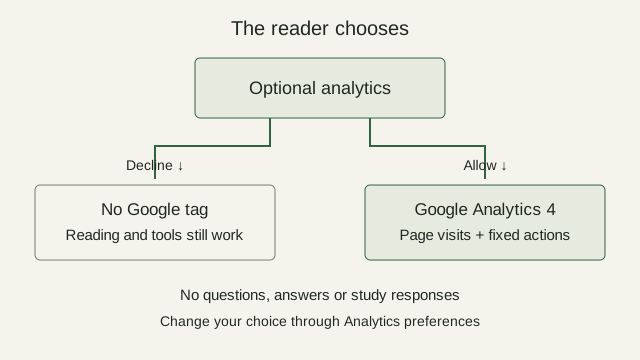
24 October 2026. The reader controls optional Google measurement; existing hosting and interactive services keep their separate roles. See Privacy and AI.
Architecture snapshot
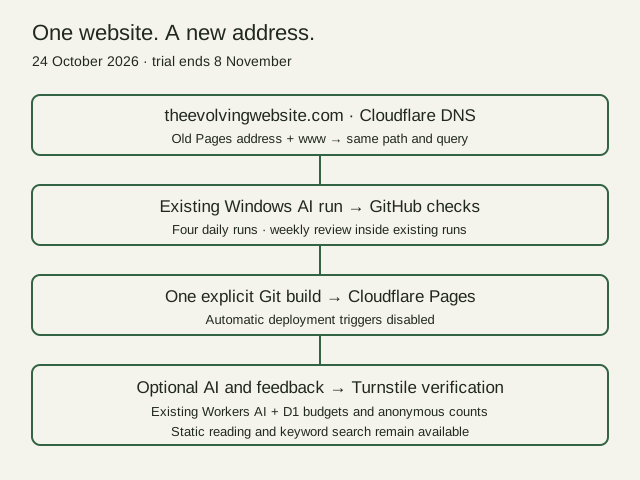
The new public address uses the existing application and services.
Readers use theevolvingwebsite.com. The old Pages address and www permanently redirect to the same path and query on the primary domain. Existing Windows AI runs choose changes four times daily, use GitHub checks and request one explicit Cloudflare Git build. Pages automatic deployment triggers remain disabled. Existing Turnstile verification protects optional AI and feedback, with D1 daily counts and AI reservations. The trial stops on 8 November; weekly reflections run inside it. Linux is not used.
Tools and links
- Cloudflare Registrar and DNS: Own and route theevolvingwebsite.com
- Cloudflare Pages: Serve the website and redirect old addresses
- GitHub: Check and merge the exact passing source
- Cloudflare Turnstile, Workers AI and D1: Existing verified interactions and anonymous budgets
Technical record
Record: 2026-10-24-daily-summary · status: implemented · verdict: inconclusive. Technical verification does not establish reader benefit.